
Why New H5N1 Cases Are Raising Pandemic Alarms
- Darn

- Jun 26, 2025
- 6 min read
Are we on the brink of another global health crisis?
Recent outbreaks of the H5N1 avian influenza virus in cows, poultry workers, and rural villages in Cambodia are alarming health experts worldwide.
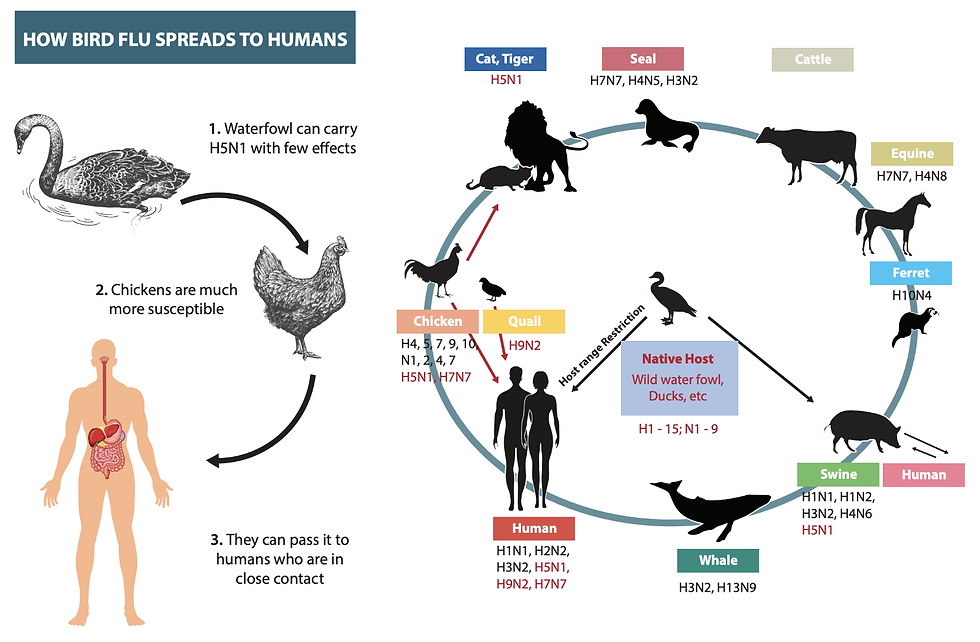
What once seemed a localized threat to birds now poses broader risks, with potential implications for human health and global public health systems. These developments point to a significant shift in the virus’s behavior, heightening fears of an emerging pandemic threat.
The Changing Nature of H5N1
H5N1, commonly referred to as “bird flu,” has long been a virus that primarily affects birds. It is highly pathogenic, meaning it causes severe disease and death in infected poultry, and it can also infect other animals, including humans.
While outbreaks have historically been confined to birds and sometimes pigs, new reports show that H5N1 is now infecting mammals, including cows and humans. These cases are drawing increased scrutiny, with many experts noting that this could represent a concerning mutation or adaptation of the virus, allowing it to expand its host range.
According to the U.S. Centers for Disease Control and Prevention (CDC), as of June 23, 2025, H5N1 has affected 13,324 wild birds across 51 jurisdictions, 174,804,048 poultry in 51 jurisdictions, and 1,073 dairy herds in 17 states.
Mammalian Infections: A Growing Concern
One of the most significant developments in the H5N1 outbreak has been the detection of the virus in dairy cows. While bovine infections were previously thought to be rare, the United States recorded its first significant outbreak of H5N1 in dairy cattle in early 2024. This is the first time that these bird flu viruses had been found in cows. In the U.S., since 2022, USDA APHIS has reported HPAI A(H5N1) virus detections in more than 200 mammals.
By mid-2024, over 1,000 cases were confirmed in dairy herds across California, Nevada, and other agricultural states. Though the virus has not yet shown clear evidence of transmission between cattle, the fact that it is able to infect mammals poses a potential risk of human transmission in the future.
Researchers are now monitoring the virus closely to see whether it undergoes any mutations that might allow it to spread more easily from animal to human.

Mammals, including humans, represent a different category of hosts compared to birds. In birds, H5N1 infection can lead to rapid transmission, as birds travel vast distances. However, in mammals, the virus may be slower to spread, though it could gain new traits that make it more dangerous. As more mammalian hosts become infected, the risk of the virus evolving into a strain that can spread efficiently among humans increases, which could eventually lead to a pandemic scenario.
The Rise of Human Infections in Cambodia
In Cambodia, the virus is already making a dangerous leap into human populations. While human infections with H5N1 have remained relatively low in recent years, the country has witnessed a surge in cases since early 2024. Cambodia is no stranger to the impact of avian influenza, having recorded some of the highest numbers of human deaths from H5N1 globally. In 2025, the country reported its fourth H5N1-related death of the year. It was a grim milestone that has raised alarm bells within the World Health Organization (WHO) and other global health bodies.
In May 2025, an 11-year-old boy from Kampong Speu province in Cambodia died after being infected by H5N1. The boy, like other recent victims, had direct contact with sick or dead poultry. This case highlights the ongoing risks of H5N1 transmission in rural communities where poultry farming is prevalent. The boy’s symptoms, including fever, cough, and respiratory distress, were typical of an H5N1 infection, which often leads to severe illness and, in some cases, death.
The Cambodian government, along with international health agencies, has increased surveillance in rural areas to prevent further outbreaks. Despite these efforts, the virus continues to spread sporadically.
The proximity of poultry farming to human populations, combined with limited access to healthcare in rural regions, creates an environment ripe for H5N1 transmission. Cambodia’s rural areas, with their dense populations and dependence on poultry for food and income, are predominantly vulnerable.
The Danger of Zoonotic Transmission
Zoonotic diseases (those that jump from animals to humans) are a growing concern in the modern world. H5N1’s recent encroachment into mammals highlights the evolving nature of zoonotic threats. In rural Cambodia, people are frequently in close contact with animals, especially poultry. Chickens, ducks, and other birds are often kept in or around homes, and it is not uncommon for people to handle sick or dead birds without protection.
This direct contact with infected animals can lead to transmission of the virus from birds to humans, particularly in cases where hygiene standards are low, or protective measures are absent. Public health experts emphasize that those working in poultry farms or live bird markets are at heightened risk of contracting H5N1. Although human-to-human transmission is still relatively rare, sporadic cases of person-to-person transmission have been reported, which could potentially lead to a wider outbreak if the virus mutates.
To reduce the risk of H5N1 in humans, authorities have focused on educating the public in affected areas about the importance of hygiene, avoiding contact with sick poultry, and reporting any unusual bird deaths. However, the persistence of the virus in rural areas where public health infrastructure is limited remains a significant challenge.
The Global Pandemic Risk
The global implications of H5N1 are far-reaching.
While the virus is not yet a pandemic threat, its spread among mammals, including cows, and increasing human cases in countries like Cambodia, raise the possibility of the virus evolving into a strain that could transmit more easily between humans. The current strain of H5N1 still requires close animal-to-human contact to infect humans, but the virus’s continued mutations raise concerns that it could eventually adapt into a more contagious form.
If this were to happen, experts warn that the consequences could be devastating. A highly contagious strain of H5N1 could potentially result in a pandemic, much like the H1N1 “swine flu” of 2009, or even more severe, as the virus’s pathogenic nature makes it far deadlier than seasonal influenza strains.
International health agencies, including the WHO and the CDC, are continuously monitoring the virus’s mutations. The goal is to detect any genetic changes early, which might indicate an increased risk of human-to-human transmission. In particular, experts are closely examining the behavior of the virus in mammals, including the spread of infection from infected animals to humans.

The potential for H5N1 to become a pandemic strain is not immediate, but experts argue that vigilance is key. Increased research into the virus’s behavior, along with global cooperation in health surveillance and containment strategies, is essential to preventing a potential pandemic. Vaccination research is also ongoing, with several countries exploring the development of vaccines that could protect both animals and humans from H5N1.
What Is Being Done to Contain the Spread?
Countries and international organizations are actively working to mitigate the spread of H5N1. In Cambodia, the government has implemented measures such as culling infected poultry, improving biosecurity protocols in farms, and educating the public about the risks of handling sick animals. Health agencies are also enhancing surveillance in rural communities, where outbreaks are most frequent.
On a global scale, organizations like the WHO are encouraging governments to improve reporting and data-sharing systems related to animal and human H5N1 infections. These efforts are crucial for early detection of outbreaks, which can help contain the spread of the virus before it reaches more populations.
Further, there is a focus on creating vaccines that could protect both poultry and humans from the virus. In some countries, including the U.S., efforts have been underway for years to develop a bird flu vaccine that could prevent large-scale poultry deaths and reduce the human health risks associated with H5N1. However, widespread vaccine distribution is still not feasible in many parts of the world, particularly in developing nations with limited healthcare resources.
A Collective Effort Is Needed
The rising alarm over H5N1’s spread from birds to mammals, including cows and humans, underlines the need for a collaborative global response. The virus’s ability to evolve and its persistence in certain regions mean that preparedness, surveillance, and swift intervention are key to managing the threat it poses.
It is clear that H5N1 is no longer simply an avian concern. The virus is spreading through new hosts, and the danger of it mutating into a pandemic strain is real. Governments, health organizations, and the public must work together to contain its spread and prevent the worst-case scenario from unfolding.
In the end, the rise in H5N1 cases is a reminder of the complex relationship between animals and humans in the spread of infectious diseases. Only through vigilance, research, and global cooperation can we hope to stay one step ahead of this evolving threat.

$50
Product Title
Product Details goes here with the simple product description and more information can be seen by clicking the see more button. Product Details goes here with the simple product description and more information can be seen by clicking the see more button

$50
Product Title
Product Details goes here with the simple product description and more information can be seen by clicking the see more button. Product Details goes here with the simple product description and more information can be seen by clicking the see more button.
$50
Product Title
Product Details goes here with the simple product description and more information can be seen by clicking the see more button. Product Details goes here with the simple product description and more information can be seen by clicking the see more button.





Comments